


70 Years of TV Advertising: WDR Features Digital Film Design in Düsseldorf
07.11.2026
A married couple in a restaurant, a sauce stain on the tablecloth and a waiter with the perfect solution: that’s what the very first commercial on German television looked like on 3 November 1956. Düsseldorf-based Henkel was advertising Persil. 70 years later, the regional TV programme WDR Lokalzeit looked at what has changed since then – and visited the Digital Film Design programme at Mediadesign Hochschule in Düsseldorf.
What has changed behind the camera?
Prof. Michael Klein, Head of the Digital Film Design – Animation/VFX programme, knows both worlds: over the past decades he has worked on many TV commercials, including for Henkel. In the WDR report, he explains that far more decisions are now made in post-production, that production has become much faster, and that social media has made spot lengths more flexible. On top of that, AI opens up completely new creative possibilities.

Prof. Michael Klein mit Studierenden von Digital Film Design in Düsseldorf. Bild: Markus Waerder/WDR
How much time does an ad have today?
The answer from students Lotta Fuchs, Rana Kavoosi and Josua Rahn is clear: just a few seconds. They hardly ever watch ads on TV any more – instead they see them on streaming platforms and social media. An ad has to show immediately what it’s about, with colour, sound and a clear message. Otherwise, people keep scrolling.
Will AI soon replace filmmakers?
For Prof. Klein, who has been working in production and problem-solving since 1987, that’s the wrong question:
“It’s not about replacing things at all, but about making things possible that you couldn’t even have begun to imagine before.
For a long time, people have been calling for schools to nurture individual talent. Thanks to AI technology and academic freedom, our students can now specialise even more in what really suits them.”
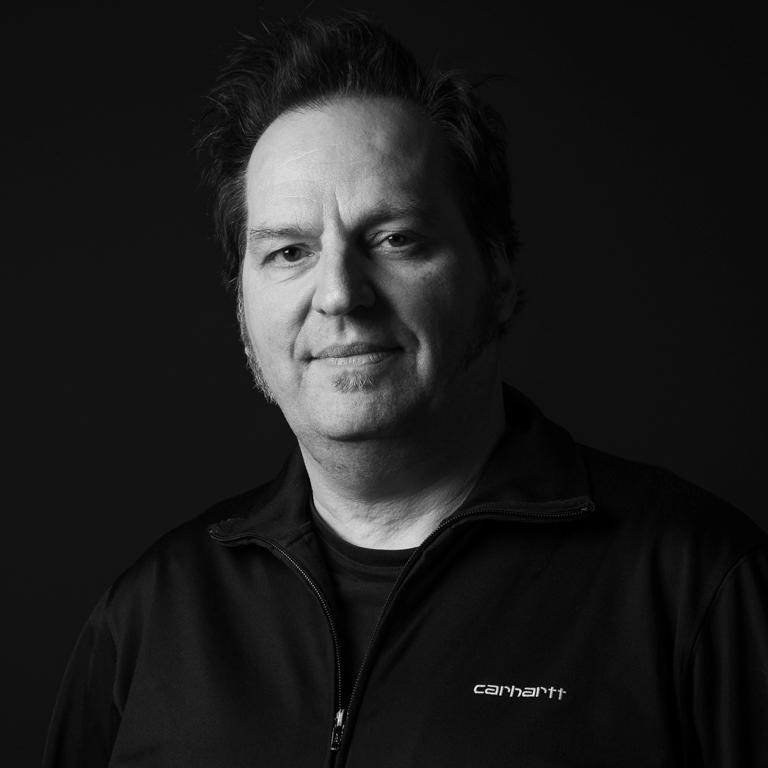
“In the analogue era, everything about a commercial had to be fixed at the planning stage. With digitalisation came the phrase ‘We fix it in the post’: you could make new decisions on set and solve things later in post-production. That phrase still applies – it is just shifting to the AI level.
Our programme isn’t being replaced by this; it is moving to its next evolutionary stage. The path from analogue to digital also went through a hybrid phase, and analogue film didn’t die – it’s just no longer an industrial tool.
Today, our students have production tools that can replace an entire film production. They build their own tools – which used to require a Technical Director – in minutes or hours. From my intensive work with AI in recent months I know: every student has an interdisciplinary team of specialists right under their keyboard. Technical limits are dissolving, because even now, in this pioneering phase, a language model can handle almost any tool. What matters, however, is that our students understand what they are doing. That’s why traditional craftsmanship remains the foundation for working with AI. And that is exactly the challenge for teaching. My experience in production and problem-solving since 1987 – on a technical, creative and communicative level – helps me with this.
The principle behind it is called ‘human in the loop’: the human understands, checks, evaluates and decides. The most important skill is problem-solving – reading, understanding, evaluating, going deeper, researching and solving a challenge systematically. Over the years, this develops into the ability to think divergently and laterally, off the beaten track. That’s why, alongside the craft, our students also learn to understand software, methods and workflows. This way, AI becomes not just a way to work faster, but a tool they use to solve their clients’ problems.
Without core competence, no tool is worth anything. With it, however, everyone can focus on their own strengths, because the generalist skills everyone used to need are increasingly built into the tools. That’s why not everyone here studies the same thing. Someone fully devoted to traditional animation, for example, can now truly pursue that – even though traditional animation isn’t part of our curriculum.”
– Prof. Michael Klein, Head of Programme Digital Film Design, Mediadesign Hochschule Düsseldorf
Want to tell stories that grab people in five seconds?
Im Bachelor Digital Film Design – Animation/VFX in Düsseldorf lernst du das Handwerk und die neuen Werkzeuge – und findest deinen eigenen Schwerpunkt.
Jetzt Bewerben